
The DCD Classical 'Cast, August 10, 2007
http://dcdrecords.blogspot.com
We celebrate the release of the "Violin Solo" series from Troubadisc Recordings. The third volume of this outstanding series concentrates on the solo violin music of Paul Hindemith, and features two of his previously unrecorded works for the violin. Eggebrecht also includes two world premiere recordings by two modern composers -- Anatol Vieru and Vladimir Martynov.
MusicWeb, November 2008
http://www.musicweb-international.com
Renate Eggebrecht has been busy preparing and recording 20th century solo violin music for a few years now, and this is volume 3 of a mounting catalogue of remarkable and often neglected works by often quite well known composers. This disc concentrates all of Paul Hindemith’s work for solo violin on one disc, including four world premiere recordings and leaving enough space for some substantial works by composers of which I had not heard.
The opening of Hindemith’s early Allegretto study is reproduced on the inside of the jewel case liner for this disc, and virtually unplayable it looks as well. The music is a kind of manic waltz, with about every kind of double-stop imaginable. This is followed by an unfinished fragment which lasts less than 30 seconds, but both items show the composer exploring the extremes of the violin while a student at the Frankfurt Conservatory.
The Sonata Op.11 no.6 was only discovered in its complete form in 2002. The musical language of this piece shows the young composer still working more with the technical aspects of the instrument rather than achieving much in the way of a personal style, though Hindemith’s virtuosity and inventive precociousness is clearly apparent. There is a good deal of wandering around in the second movement Siciliano, and as with the Studien the double stopping and range is a killer.
The Sonata fragments which follow are from some time in the first half of the 1920s, and are certainly more distinctive in terms of an already remarkable personal language.
Hindemith’s own instrument was of course the viola, and the Op. 31 sonatas were written for his violinist quartet colleagues rather than for his own use. The finish and sense of commitment in these pieces is a little in question, at least two of the movements in the first of the pair and the Sonata No.2 having been jotted down during a train journey, but this also serves to illustrate Hindemith’s swift imagination and flexibility. Both sonatas employ lyrical song forms, the final movement of the second sonata even quoting a Mozart song. The first sonata extends asymmetrical melodic patterns to the extent that structure appears distorted in even quite compact movement durations, but the Hindemith fingerprint intervals and gestures are more often present. The Sonata No.2 is less intense, having a sunnier, more pastoral feel than the first from the start. This is also reflected in the title of the first movement "...Es ist so schönes Wetter draußen" ("... it's such beautiful weather outside"). The final variations on Mozart’s “Komm, lieber Mai” come as quite a surprise, and as a point of programming lead nicely into the next piece.
Anatol Vieru came from the Romanian province of Moldovia, and studied with Aram Khachaturian in Moscow. Using folk music as a base, his avant-gardism is recognised as having a quietly subversive character, and this is also a characteristic of the brief Capriccio. There are a number of techniques listed in the booklet notes, but the end result is that it sounds like more than one violinist at work at several points in the piece, left-hand pizzicato playing an interesting role. The Capriccio is a compact and satisfying work with its own substance and life, though I’m sure it would work well as a surprise encore.
Vladimir Martynov is another unfamiliar name to me, and his Partita of 1976 is unlike any of the other pieces on the disc. Kerstin Holm describes it as “raw, Russian Minimal Music with arte-povera appeal” in the booklet notes, and this sums up the general impression very well. The actual musical material is quite folk-like and basic, but with repetition of a basic phrase with variations each movement and the piece as a whole has quite a hypnotic quality. The opening of the third movement is almost a direct quote – at least in terms of gesture – of Terry Riley’s ‘In C’. It would be interesting to take this kind of material and extend it with some of Steve Reich’s phasing techniques, or explore the canonic effects of layering the music, but as it stands this piece is great fun. Either that or it will drive you up the wall and back down again, but I happened to quite like it. Martynov argues that anyone still composing music in the conventional sense in these days of computer DJ-ing is ‘nothing but a clown.’ His loss: I can see the point but, having done both, would say live and let live.
The SACD sound quality on this disc is very good indeed, making a sonic feast of what threatens to be something of a strain on the brain and ears. The resonance seemed to sound quite different on different systems, and at times I was tempted to thin everything back to stereo for clarity’s sake, but the violin tone and presence is always very fine indeed.
The fascination of hearing such rare and unusual repertoire outweighs the considerations however, and those fascinated by Hindemith’s admittedly finer solo viola sonatas should also be encouraged to explore his violin repertoire – if only to find out how he seemed to seek revenge on his violinist colleagues in the early years!
Dominy Clements
Wochen-Kurier mit dem Heidelberger Amtsanzeiger, 29. 08. 2007
Es ist doch immer wieder verblüffend zu hören, welche Möglichkeiten in den vier Saiten einer einzigen, unbegleiteten Geige stecken. Und das nicht, weil auf dem Griffbrett zwischen den offiziellen Tönen des Systems unendlich viele Lösungen stecken ...
Renate Eggebrecht hat in ihren Aufnahmen immer wieder mit umfassender Repertoirekenntnis, viel Geschmack und künstlerischer Risikobereitschaft diskographische Mischungen erzeugt, die sich in vieler Hinsicht als explosiv erwiesen. Die Verbindung von Max Reger und Johanna Senfter mit Nikos Skalkottas und Arthur Honegger oder das Aufeinandertreffen von Béla Bartók, Grazyna Bacewicz, Erwin Schulhoff und Darius Milhaud resultierten in zwei unverwechselbaren Produktionen des Labels Troubadisc, das jetzt mit Violin Solo 3 ein nicht weniger buntes und idiosynkratisches Programm mit mehreren Weltersteinspielungen herausbringt.
Die 30 Jahre alte Partita des russischen Extremminimalisten Vladimir Martynow und das feine, späte Capriccio des Rumänen Anatol Vieru sind allein schon Welten voneinander entfernt. Und dann kommt – Paul Hindemith. Rund vierzig Minuten dauert es, seine sämtlichen Solostücke für Geige zu spielen, doch was sich in dieser knappen Dreiviertelstunde ereignet, ist tatsächlich ein in sich geschlossenes Charakterbild. Hindemith, der Bürgerschreck, der auf seinem Instrument jodelt und zwitschert und dennoch unter der schmorenden Oberfläche den klassischen Kern des „deutschen Meisters” nicht verbergen will; der die Gesetze entdeckt, die er sich selbst gegeben hat; und der unter dem Einfluß des Volksliedes allmählich in die Bahnen dessen gerät, was man als seinen unverkennbaren, reifen Stil identifiziert – das alles findet in diesen wenigen Stücken statt, von denen zwei bislang noch nicht aufgenommen wurden, weil sie Fragmente blieben. Wertvolle und aufschlußreiche Fragmente freilich, die der vorliegenden Neuproduktion zusätzliche Sprengkraft verleihen.
E.H.

LAST Change: Friedemann Kupsa
(05.02.2019 - 19:06 Uhr)
Webdesign VehemenZa
CMS myty by tyclipso.net ©2005
troubadisc.de a belle artes project
Complete works for solo violin
Studien (1916)
Sonata op.11 Nr.6 (1918)
Satz und Fragment (1925)
Sonatas op.31 Nr.1 & Nr.2 (1924)
Anatol Vieru, Capriccio (1997)
Vladimir Martynov, Partita (1976)
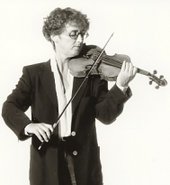
Renate Eggebrecht, violin
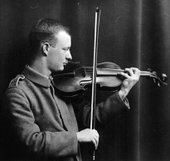
Paul Hindemith 1916
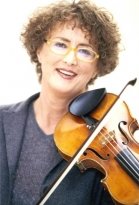
Renate Eggebrecht