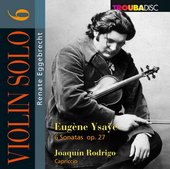
Renate Eggebrecht plays the Ysaӱe Sonatas and Rodrigo’s Capriccio
Eugène-Auguste Ysaÿe (1858-1931) was one of the greatest violinists of his age. He also left behind some 50 compositions, of which his set of six Sonatas for Unaccompanied Violin, op. 27, is especially important. Completed in 1924, they represent an opus summum of both compositional and violin technique. Each one is dedicated to a great violinist or composer and specially tailored to his artistic personality. Each also tackles sonata form in a different way. They are perhaps Ysaÿe's best-known works and have attracted entire generations of artists.
The violinist Renate Eggebrecht discovered these pieces while still a student after buying a fine early edition of them in a second-hand music shop in Munich. Now, after a lifetime of studying the Ysaÿe sonatas, she has fulfilled a long-cherished dream by recording them for the sixth volume of her Violine Solo series. She began by returning yet again to the sources: 'I used the heavily altered and corrected definitive version for my recording – namely, the eighth personal copy to leave the printing press, signed “May 1926” in Ysaÿe's hand.' The multi-channel CD recording allows the violin to display its nature and timbre to full advantage.
Ysaÿe is still largely neglected as a composer. Renate Eggebrecht is thus all the more concerned to show, with her readings, where he should be placed among the great composers for the solo violin and what magnificent things he achieved in this area: 'Ysaÿe's trailblazing expansion of violin technique led music into uncharted territory: Bartók, Milhaud, Schoenberg, Denisov and many others pursued his discoveries in their own violin music.'
Another aspect that fascinates her about the Ysaÿe sonatas is their relation to the music of Johann Sebastian Bach, whose set of three sonatas and three partitas she has likewise recorded for Violine Solo: 'Ysaÿe's six sonatas were conceived as a modern-day response to Bach's music and a renewal of the message they contain.' In the Fourth Sonata, dedicated to Fritz Kreisler, she effectively combines the vitality of Baroque dance pieces with a certain rigour, unveiling in the central Sarabande a sonorous and delicate pizzicato reminiscent of a Baroque lute.
One special highlight is the Second Sonata, whose four movements form a cycle of paraphrases on the famous medieval sequence Dies irae – a piece especially beloved of French composers ever since the final movement of Berlioz's Symphonie fantastique. Renate Eggebrecht's readings of Ysaÿe thus cover an enormous range, from the rigorous introduction of the First Sonata, with its acerbic harmonies almost recalling Siegfried Karg-Elert, to the cycle's galant finale, the Sixth Sonata, whose Spanish tinge kindles memories of Georges Bizet.
With brilliant virtuosity, poetic lyricism, a vast range of expression and rhythmic verve, Renate Eggebrecht delves deep into the character portrait of each dedicatee.
Rounding off the Ysaÿe sonatas as a sort of epilogue is the Capriccio by Joaquín Rodrigo (1901-1999). Composed in 1944 as a tribute to the great violinist Pablo de Sarasate, Renate Eggebrecht finds it 'a pièce de resistance of rich-hued impressionistic neo-classicism and daredevil virtuosity for the solo violin'. For this piece she has developed highly experimental performance techniques and plays here with special esprit.
VIOLIN SOLO Vol.6
Eugène Ysaӱe (1858-1931)
Six Sonatas op. 27 for Violin solo (1923/24)
Sonata op. 27/1 à Joseph Szigeti
Sonata op. 27/2 à Jaques Thibaud
Sonata op. 27/3 à George Enescu
Sonata op. 27/4 à Fritz Kreisler
Sonata op. 27/5 à Mathieu Crickboom
Sonata op. 27/6 à Manuel Quiroga Losada
Joaquín Rodrigo (1901-1999)
Capriccio Offrande à Sarasate for Violin solo (1944)
I am not a music critic but "only" a study violinist.
But that is precisely the reason why I would like once again to say how important such a CD with Ysaye's solo sonatas. The violinist Renate Eggebrecht sets every even the smallest instruction of the composers, with a technical brilliance and musical self-evident that I can only wonder. Ysaye has of metronome markings, game techniques to subtle expression information everything carefully in the score. I have never seen such a meticulous and at the same time intensive, game technically highly brilliant playback heard: I can only be amazed!
The Capriccio of Joaquin Rodrigo is absolutely fascinating: the light, precise arc, the wonderful sung lines, rhythmic finesse and at the same time a single joy of life, the violinist is all about!
The booklet is for me is also an important point, not only because of the insightful information texts but also because I have had a very stimulating information, e.g. via the "Preludes" of Ysaye, or even very interesting quotes from him.
The level of this CD is so high that I this publication with the violinist Renate Eggebrecht exuberant only recommend it!
David Bochmann 03.12.4014

LAST Change: Friedemann Kupsa
(05.02.2019 - 19:06 Uhr)
Webdesign VehemenZa
CMS myty by tyclipso.net ©2005
troubadisc.de a belle artes project
Six Sonatas for Violin solo op.27 (1923/24)
Joaquín Rodrigo (1901 - 1999)
Capriccio (1944)
Offrande a Sarasate
Renate Eggebrecht, violin