MusicWeb International
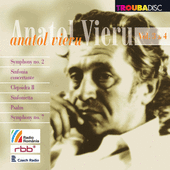
This fascinating 2 CD set from the Munich-based label Troubadisc constitutes volumes 3 and 4 in their ongoing Anatol Vieru series. I've already had the pleasure of reviewing the previous two volumes. It's helpful to consider Vieru's challenging but deeply rewarding music against the backdrop of his biography. He was born on 8 June 1926 in Iaşi, Romania. In 1941 the country entered the war, agreeing to collaborate with the Nazis in the extermination of European Jewry. As the male Jews were mustered together for slaughter in a courtyard in Iaşi, Vieru's father had the presence of mind to escape with his two sons at the last minute. With the cessation of hostilities, Anatol enrolled at the Bucharest School of Music in 1946. He remained there until 1951. In 1954 he travelled to the Tchaikovsky Conservatory in Moscow to complete his studies with Aram Khachaturian. This launched him on a career as composer, conductor and teacher. He composed four operas, seven symphonies, several concertos, eight string quartets, other chamber works, several film scores and some choral and vocal music. He taught at the Bucharest Conservatoire from 1950 -1985. He died in 1998. The Symphony No. 2 dates from 1973, and is here receiving its world premiere performance a year later. It's cast in three interlinked movements. The first has the strange title Tachycarie, which translates as ‘heart palpitations’. Vieru depicts this arrhythmia in jolting stop/start rhythms, with the music never relaxing for a single moment. His imaginative use of percussion instruments adds some brightly coloured sonorities to the mix. Psalm follows, and the music settles. Use is made of a hymn-like tune, its religious character reinforced by the occasional chiming bell. Bird sounds and primeval cries evoke a surreal landscape, populated with multifarious life forms, set against a backdrop of diaphanous orchestral chording. The finale Melodie Descatusata is nervous and spiky and what I can only describe as pointillistic.
Fourteen years later in 1987, Vieru penned his five-movement Sinfonia Concertante for cello and orchestra. Once again the movements are linked, with just a brief pause between movements 3 and 4. Having listened to it two or three times it seems like one long undulating narrative with the protagonist, here the solo cello, playing continuously. It opens with the tuba, evoking a dark, sombre atmosphere. The cello line is forlorn and anguished. Eventually it becomes more biting and percussive. Double stops, fingered octave glissandi and uncomfortable intervals place formidable demands on the soloist. Ivan Monighetti is fully up to the task, and his intonation is spot on. The third movement offers some respite. The music becomes dreamlike and otherworldly, almost soporific. Vieru achieves this by considerably lightening the orchestration. The fourth movement's roughly-hewn textures contrast with the calm and serenity of the fifth movement.
Clepsidra 11 is the earliest piece here, written in 1971. It's the highlight of the set for me. Vieru calls on the services of chorus, panpipes, cimbalom and orchestra for this superbly constructed and immensely powerful score. All the emotions known to man - joy and terror, grief and solace, disappointment and hope and earnestness and humour - are all there. The performance sounds well-rehearsed and ensemble between the various groups is second-to-none. The set is worth its price for this work alone.
The Sinfonietta (1975) is here receiving its premier outing. It was a commission to celebrate the 50th anniversary of the founding of the Prague Radio Symphony Orchestra in 1926, the year, incidentally, that the composer was born. As a sign of respect to the Czech players, the work is heavily indebted to Leoš Janáček who was, no doubt, an influence for the impressive fanfare introduction. Bombastic and garishly coloured, it makes for a spectacular orchestral showpiece. The short orchestral piece Psalm was composed in 1993. The title refers to its profound, reverential demeanour. There could be no greater contrast between the deeply felt spiritual feelings that permeate this work, and the boisterous melee of the preceding Sinfonietta.
The Seventh Symphony is Vieru’s farewell to the form. It was composed in 1992-1993 when he was composer-in-residence at New York University. Its title is 'The year of the Silent Sun'. The opening movement Prelude is tranquil and luminous and, for the most part, understated. Vieru quotes the Christmas carol Silent Night at various points. He employs delightful woodwind writing and some powerfully atmospheric pianissimos. The second movement has the enigmatic title of Loops. It has the character of a capricious and whimsical scherzo. The finale is titled Hymn and the chiming bells make an appearance. Everything is calm and restrained, yet there's an underlying unease. At the end, however, the work appears to find peace and contentment.
These performances emanate from several sources, including Czech and Romanian radio. The actual recording dates are not given, with the exception of the two world premieres. These were taped in 1974 and 1975. The quality of the recordings are uniformly excellent, which leads me to assume that all were set down around the same time. I couldn't detect any audience presence in any of them. Egbert Hiller's annotations in English, French and German are helpful. I hope that there'll be more Vieru to come in this absorbing series.
Stephen Greenbank
http://www.musicweb-international.com/classrev/2018/Feb/Vieru_v34_TROCD01451.htm
‘Heart palpitations’ and ‘intervallic thought’:
the orchestral music of Anatol Vieru
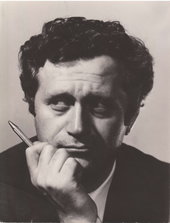
For the Rumanian composer Anatol Vieru (1926-1998), every hour he lived and every note he committed to paper must have seemed like a miracle when he thought back to a particular day in June 1941. Romania had entered the war against the Soviet Union on Germany's side, and had agreed to take part in the Nazi régime's extermination of European Jewry. When all the male Jews in Iaşi were told to assemble, Anatol was able to flee with his father and brother. Thousands of others were cruelly murdered.
In later years Vieru never spoke of this in public. Part of the reason was that, in the age of communism, their country's involvement in the Holocaust was taboo and banished from official history. It is natural to suppose that this crucial experience, magnified by the silence that descended upon it, was 'communicated' via other channels, and that he dealt with it in his creative work. But Vieru’s music refuses to be boiled down so simply, for what is captivating about his musical language is precisely its multi-layered diversity.
Tachycardie
After World War II had come to an end, Vieru first studied at the Bucharest School of Music. At the same time he performed such important functions as heading the Bucharest National Theatre and editing the official journal of the Rumanian Association of Composers. He first drew attention in the West in 1962 by winning the Prix International Reine Marie-José in Geneva with his First Cello Concerto. In 1973 he received a scholarship from the German Academic Exchange Service (DAAD) for a one-year stay in West Berlin. The same year witnessed the birth of his Simfonia II, whose the opening movement, 'Tachycardie' (heart palpitations), finds acrid rhythms colliding with luminous sheets of sound
'... it belongs, it doesn't belong ...'
The constructive principle behind Vieru’s music, according to Thomas Beimel, is based on tiny modes with which he allegorically depicts the social processes of inclusion and exclusion along the lines of set theory: it belongs, it doesn't belong, it has features in common. This allegory reflects Vieru's own threatened existence – his 'Jewish identity', of course, but also his later identity as a Rumanian artist subject to the strict surveillance and control of the régime. Proceeding from the modes, he then arrived at a model of intervallic thought that plays an important role in his five-movement Simfonia concertanta for cello and orchestra (1987), including subliminal associations with folk music.
Whether the (bloody) end of Ceaucescu's dehumanising reign seemed to Vieru like a dream, or whether he had expected it all along, is a matter of speculation. In any event, he had resisted Rumania's dictatorship with his art, refusing to let himself be co-opted by the system. In the final decade of his life he enjoyed his newly-won liberties and took pleasure in his growing international acclaim.
Egbert Hiller

LAST Change: Friedemann Kupsa
(05.02.2019 - 19:06 Uhr)
Webdesign VehemenZa
CMS myty by tyclipso.net ©2005
troubadisc.de a belle artes project
Symphony no.2 (1973)
Deutsches Symphonie-Orchester Berlin
Conductor: Andrzej Markowski
Sinfonia Concertante for cello and orchestra (1987)
Orchestra Filarmonicii "George Enescu" din Bucuresti
Soloist: Ivan Monighetti, cello
Conductor: Horia Andreescu
World premiere performance 1974
Clepsidra II (1971)
Orchestra simfonica a Radioteleviciunii si Corul de camera Madrigal
Soloists: Gheorge Zamfir, panpipes; Toni Iordache, dulcimer
Conductor: Ludovic Bács
CD II - Vol.4
Sinfonietta (1975)
Prague Radio Symphony Orchestra
Conductor: Josef Hrncir
World premiere performance 1975
Psalm (1993)
Orchestra de Camera Radio
Conductor: Ludovic Bács
Symphony no.7 (1992/93)
"Anul soarelui calm" (The year of the Silent Sun)
Orchestra Nationala Radio
Conductor: Horia Andreescu