
press information
Arthur Honegger's La Danse des morts and Frank Martin's Requiem
Catholic Mysticism and Expressionist Austerity
For a long time, twentieth-century Swiss music was hardly noticed at all. Arthur Honegger, a former member of Les Six, was treated to all intents and purposes as a Frenchman, and the historical significance of such masters as Othmar Schoeck and Frank Martin was underplayed. To be sure, the lasting success of some of Martin's works, above all the oratorio Golgotha, have brought about a change of view on their own and elevated him to the status of a "classical modernist." In contrast, Honegger's star has slightly faded in the half-century since his death, although he wrote several works that figure among the great myths of modern music: the oratorios Le roi David and Jeanne d'Arc au bûcher, say, or the machinist tone-poem Pacific 231 and the Symphonie liturgique. Arthur Honegger (1892-1955) and Frank Martin (1890-1974) were the two most important composers to emerge from Francophone Switzerland. Not only were they almost age-mates, they were both filled with a philosophical and religious idealism whose intensity found expression in excruciating dissonances and, despite their splendidly dark timbral garb, in an soberly austere and expressionist posture that parted ways with the perfervid yearnings of the late romantics.
Honegger's La Danse des morts, for solo voices, chorus, orchestra, and narrator, was composed in 1938 after the success of his oratorios Le roi David and Jeanne d'Arc au bûcher. It arose in close collaboration with the great poet Paul Claudel, who not only wrote the words but was responsible for the dramatic structure. He was inspired to write La Danse des morts by the Basle Dance of Death, a series of woodcuts by Hans Holbein the Younger. According to Honegger, Claudel's Danse des morts, with its pan-Christian message, contains "long paraphrases of the Bible, Ezekiel's vision, fragments from Job, lightly recast folksongs, screams, sobs, [and] Latin phrases." This richly diverse half-hour work, itself partly resembling a woodcut, describes an arch from its dramatic introduction through the intricately contrapuntal and morbidly skeletal folk song collages of the danse macabre, a hypnotically moving lamentation, and the collective screams and sobs to its powerfully affirmative ending. In this recording, Christoph Bantzer integrates the spoken French texts into the musical events with astounding empathy. La Danse des morts has always been somewhat overshadowed by Honegger’s preceding oratorios. Now, in this exhilarating performance, it is given something akin to a belated resurrection.
Unlike Honegger's Danse des morts, which arose as it were in the fullness of life, Frank Martin wrote his Requiem after a long postponement in 1972, when he was over eighty years old. It is a work of almost forty-five minutes' duration with a powerful Dies irae full of jarring contrasts – one of those late works, as erratic as they are overwhelming in their maturity and mastery, in which the composer takes stock of his life's experiences and philosophy and lends transfigured yet deeply shattering expression to the cries of a century of horrors. Martin was always a man of faith and integrity. His Requiem (for solo voices, chorus, orchestra, and organ) is the internalized climax of his sacred music, a piece whose display of inner suffering and transcendent sadness, verging almost on detachment, ensures that it will never be popular. Yet its mood, meandering through multiple layers between acerbity and serenity, will be all the more meaningful to those who look for more in music than a resplendent surface. This work of art is profound in the fullest sense of the term: the further we penetrate into its mysteries, the more it gives us in return. To this end, the searingly urgent performance by the Choir of St. Nicholas's in Hamburg and the Hamburg Camerata, conducted by Mathias Hoffmann-Borggrefe with outstanding solo vocalists, provides the best possible preconditions.

LAST Change: Friedemann Kupsa
(05.02.2019 - 19:06 Uhr)
Webdesign VehemenZa
CMS myty by tyclipso.net ©2005
troubadisc.de a belle artes project
Poem of Paul Claudel
for Spreaker, soloists, choir, orchestra and organ
Frank Martin, Requiem (1972)
for soloists, choir, orchestra and organ
Kantorei St. Nikolai, Hamburg
Hamburger Camerata
Christoph Bantzer, spreaker
Katherina Müller, soprano
Kaja Plessing, alto
Michael Connaire, tenor
Stefan Adam, bass
Jürgen Henschen, organ
Stephanie Daase, harpsichord
Conductor: Matthias Hoffmann-Borggrefe
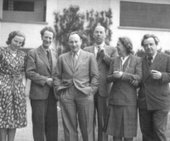
Frank Martin, Paul Sacher, Arthur Honegger a.o.
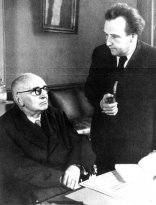
Paul Claudel and Arthur Honegger
Martin conducting the world premiere of the Requiem, Lausanne 1973

TRO-CD 01441